
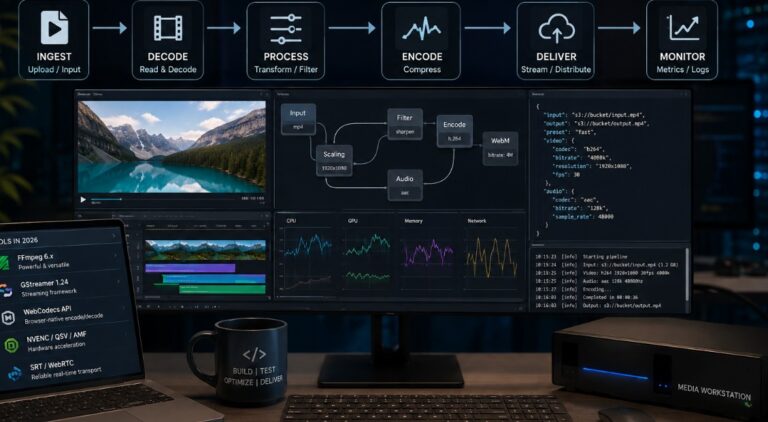
The demand for robust media processing capabilities has never been higher. As applications increasingly rely on rich media content, developers need practical knowledge of video processing tools, APIs, and architectural patterns that enable efficient media handling at scale. From content management systems to social platforms, the ability to process, transform, and deliver video content is becoming a core infrastructure requirement.
This guide explores the current landscape of media processing technologies, focusing on practical approaches that developers can implement in their projects. We will examine both server-side processing pipelines and client-side optimization techniques, providing actionable insights for building performant media-aware applications.
Understanding Modern Video Processing Architecture
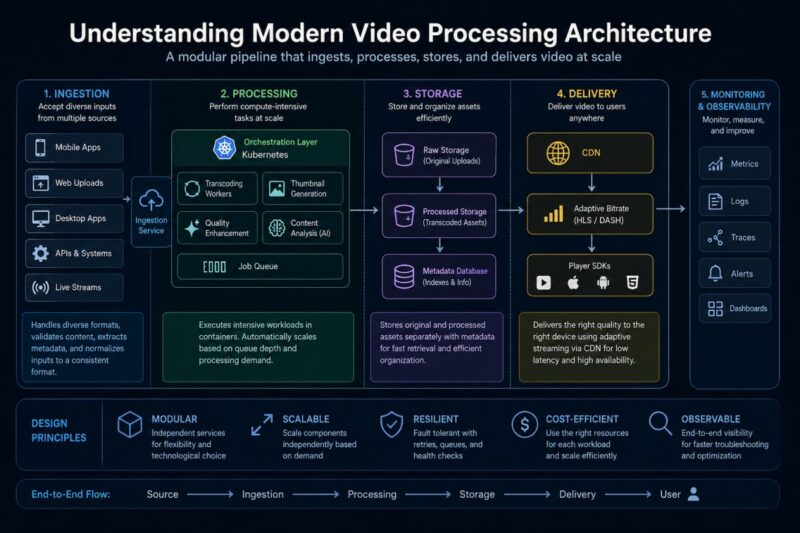
Modern video processing pipelines typically follow a modular architecture that separates ingestion, processing, storage, and delivery into distinct services. This separation allows teams to scale individual components independently and adopt specialized technologies for each stage of the pipeline.
At the ingestion layer, applications need to handle diverse input formats and sources. Users may upload content from mobile devices, desktop browsers, or automated systems, each with different codec preferences, resolution constraints, and metadata formats. A well-designed ingestion service normalizes these inputs into a consistent format for downstream processing.
The processing layer handles computationally intensive tasks such as transcoding, thumbnail generation, quality enhancement, and content analysis. Container orchestration platforms like Kubernetes are commonly used to manage processing workloads, allowing automatic scaling based on queue depth and processing demand.
FFmpeg and Server-Side Processing
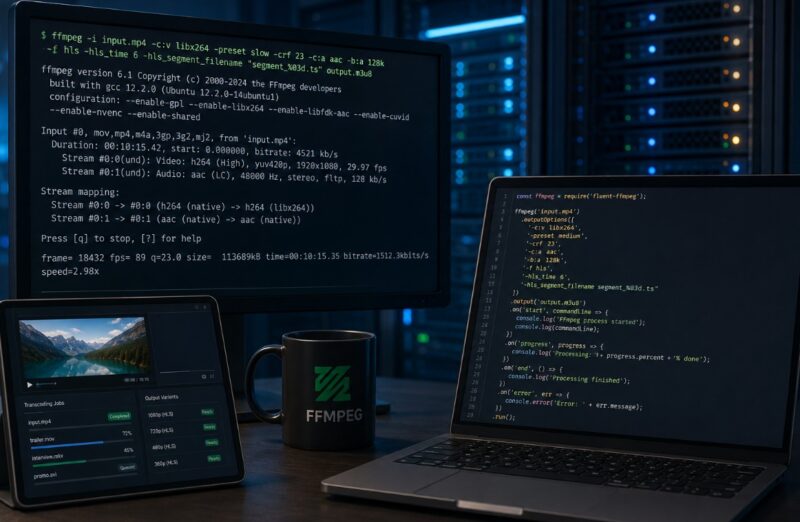
FFmpeg remains the cornerstone of server-side video processing. This open-source toolkit provides comprehensive codec support, powerful filtering capabilities, and reliable performance across diverse hardware environments. Understanding FFmpeg’s command-line interface and programming API is essential for any developer working with video content.
Common FFmpeg operations in production pipelines include adaptive bitrate encoding for streaming delivery, format conversion for cross-platform compatibility, and quality-preserving compression for storage optimization. Modern FFmpeg builds include hardware acceleration support for NVIDIA CUDA, Intel Quick Sync, and AMD AMF, enabling significant performance improvements on appropriately equipped servers.
For developers building web applications that need to integrate video processing capabilities, wrapper libraries in Python, Node.js, and other languages provide convenient abstractions over FFmpeg’s native interface. These libraries simplify common tasks while still allowing access to the full power of the underlying toolkit when needed.
Content Delivery and Optimization
Efficient video delivery requires careful attention to encoding parameters, delivery protocols, and caching strategies. HTTP Live Streaming and Dynamic Adaptive Streaming over HTTP are the dominant adaptive streaming protocols, allowing players to adjust quality dynamically based on available bandwidth and device capabilities.
Content delivery networks play a critical role in ensuring low-latency, high-quality video delivery to global audiences. Understanding CDN configuration, including cache key design, origin shield placement, and purge strategies, is essential for maintaining reliable video delivery at scale.
Client-side optimization is equally important. Modern browsers provide powerful media APIs that enable features like lazy loading, intersection observer-based playback, and responsive video element sizing. Tools like {{LINK}} demonstrate how client-side video processing can be used to provide users with flexible options for accessing and managing video content across different platforms and formats, highlighting the importance of user-friendly interfaces in media tool design.
WebAssembly and Browser-Based Processing
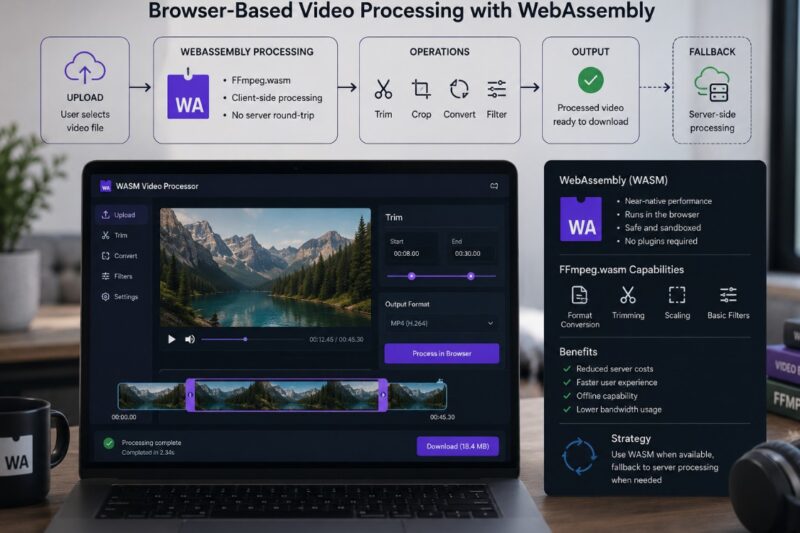
WebAssembly has opened new possibilities for performing video processing operations directly in the browser. Libraries like FFmpeg compiled to WASM enable tasks such as format conversion, trimming, and basic editing without requiring server round-trips. This approach reduces server costs and improves user experience by providing immediate feedback.
The performance characteristics of WASM-based video processing continue to improve with each browser release. While not yet matching native performance for heavy computational tasks, WASM processing is increasingly viable for lightweight operations that benefit from client-side execution.
Progressive enhancement strategies allow applications to leverage WASM capabilities when available while falling back to server-side processing for unsupported browsers or resource-intensive operations. This hybrid approach provides the best balance of performance, compatibility, and cost efficiency.
API Design for Media Services
Designing APIs for media processing services requires careful consideration of asynchronous workflows, progress reporting, and error handling. Video processing operations are inherently long-running, making synchronous request-response patterns unsuitable for most production use cases.
Event-driven architectures using message queues provide natural patterns for managing video processing workflows. Services can publish events when processing stages complete, enabling downstream services to react accordingly. This loose coupling improves system resilience and makes it straightforward to add new processing steps to the pipeline.
Webhook callbacks and server-sent events provide mechanisms for notifying client applications when processing operations complete. Well-designed media APIs also provide progress endpoints that allow clients to display meaningful progress indicators during long-running operations.
Machine Learning Integration
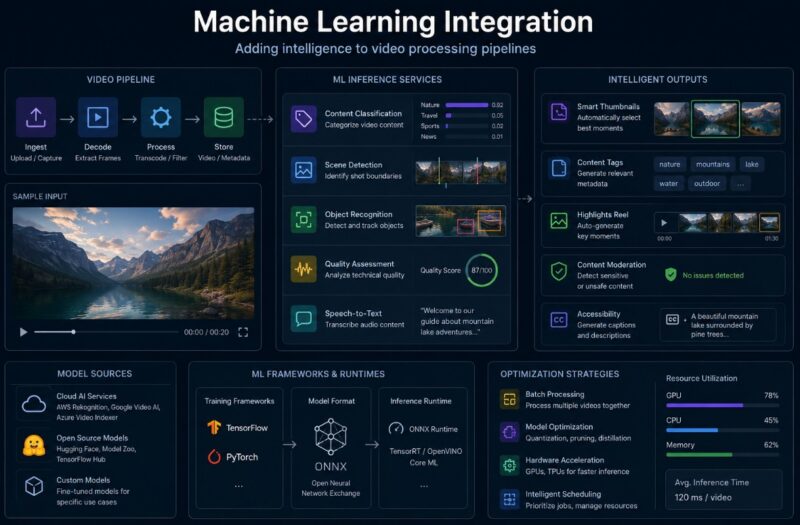
Machine learning models add intelligence to video processing pipelines through capabilities like automatic content classification, scene detection, object recognition, and quality assessment. TensorFlow, PyTorch, and ONNX Runtime provide frameworks for deploying these models in production environments.
Pre-trained models for common video analysis tasks are increasingly available through cloud AI services and open-source model repositories. Developers can integrate capabilities like automatic thumbnail selection, content moderation, and accessibility feature generation without building models from scratch.
The computational requirements of ML inference can be significant for video content. Batching strategies, model optimization techniques like quantization and pruning, and GPU scheduling help manage these costs while maintaining acceptable processing latencies.
Monitoring and Observability
Production video processing systems require comprehensive monitoring to ensure reliable operation. Key metrics include processing latency, queue depth, error rates, encoding quality scores, and storage utilization. Tools like Prometheus, Grafana, and custom dashboards provide visibility into system health and performance trends.
Quality of service monitoring for video delivery should include client-side metrics like startup time, rebuffering ratio, and bitrate switching frequency. These metrics directly impact user experience and should be tracked alongside infrastructure metrics to provide a complete picture of system performance.
As video processing systems grow in complexity, investing in observability infrastructure pays dividends through faster incident detection, more efficient capacity planning, and data-driven optimization decisions. The technology ecosystem for monitoring continues to mature, making it easier than ever to build comprehensive observability into media processing pipelines.